
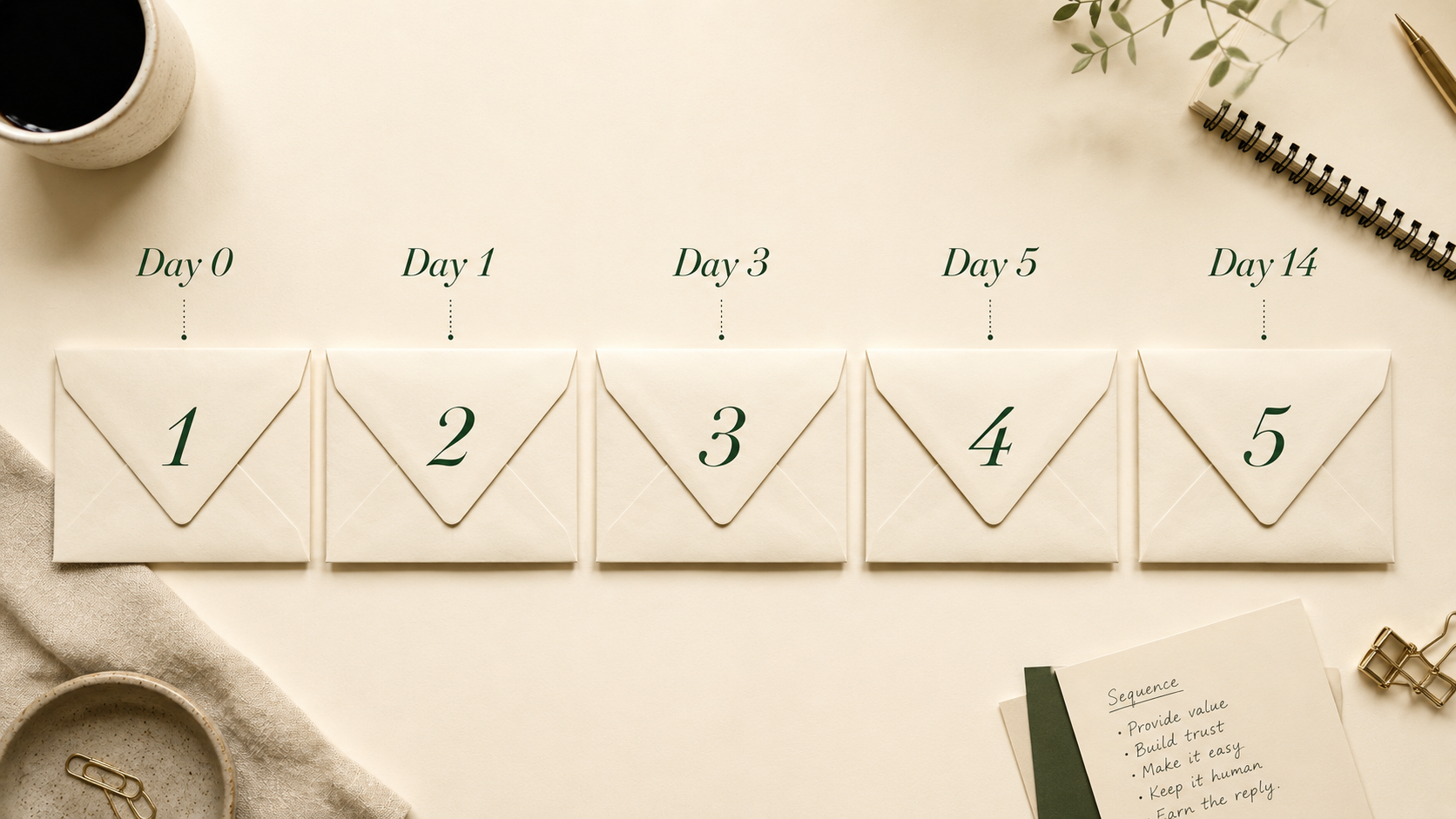
The welcome flow is the highest-ROI campaign you will ever build. A new subscriber's first 14 days will produce 4–6× the open rate of your steady-state newsletter, the highest click-through rate of any send you do all year, and the best chance you'll get to turn an opt-in into an actual customer.
Most teams get this wrong. They either send one "thanks for subscribing" email and stop, or they overload the new subscriber with a daily blast for two weeks. Neither builds a relationship.
Here's a five-email welcome flow with the timing, subject patterns, and body templates we use ourselves. Copy it verbatim. Adapt it to your voice. Just run it.
Why the welcome flow matters more than the newsletter
Three numbers explain it:
- Open rates on welcome emails are 50–86%. Steady-state newsletter opens, for the same brand, are typically 18–34%.
- Click-through rates are 3–6× higher than your newsletter.
- Subscribers who go through a welcome series convert at 2–3× the rate of subscribers who get dropped into the newsletter cold.
That's not because welcome emails are written better. It's because the recipient is paying attention. They just gave you their email. The 14-day window is the only time they will be reliably curious about you.
The welcome flow is the conversation. The newsletter is the relationship. You can't have the relationship if you skip the conversation.
The 5-email blueprint at a glance
- Email 1 — The receipt. Sent within 2 minutes. Confirms the signup, sets expectations.
- Email 2 — The story. Sent ~24 hours later. Tells the brand's "why" in 250 words.
- Email 3 — The proof. Sent on Day 3. One specific customer outcome or testimonial.
- Email 4 — The offer. Sent on Day 5. The lowest-friction next step (a free trial, a starter product, a specific service).
- Email 5 — The check-in. Sent on Day 14. Asks one question. Real reply expected.
That's it. Five emails. Fourteen days. No daily barrage, no manufactured urgency.
Email 1 — The receipt
Goal: Confirm the signup, deliver whatever was promised at opt-in (lead magnet, trial credentials, first issue), and set expectations for what's coming.
Timing: Within 2 minutes of signup. Speed matters. The subscriber is still on the site or in their inbox, looking for the confirmation.
Subject lines that work:
- Welcome to [brand], [first name]
- Here's your [thing they signed up for]
- You're in. (Read this first.)
Body template:
Hi [first name],

Thanks for signing up. Here's what you asked for:
[link to the lead magnet / trial / first issue]

Quick heads-up on what to expect:
- Tomorrow, I'll send you the story behind [brand].
- A few days after that, a customer who's been with us for [time].
- One week in, the easiest way to get started with us.
- Two weeks in, I'll check in and ask how it's going.

That's it. No daily blasts. No tricks.

Talk soon,
[founder first name]
Why it works: It does the one thing the subscriber expected (deliver the asset), and it pre-frames the rest of the flow so subsequent emails feel like fulfilled promises, not interruptions.
Email 2 — The story
Goal: Earn the right to email them again. The single most under-used asset in B2B and DTC email is the founder's actual reason for building the thing. Tell it once, well, and you've raised the ceiling for every email after.
Timing: 22–26 hours after Email 1. The 24-hour mark is meaningful — far enough that the receipt has been processed, close enough that the subscriber still remembers signing up.
Subject lines that work:
- Why I started [brand]
- The thing that bugged me for [years]
- How [brand] got started (250 words)
Body template:
Hi [first name],

When I was [role / situation], I kept running into [specific problem].
Most solutions I tried were [too X, too Y, or both].

So I built [brand].

The thing I cared most about getting right was [the one thing
that differentiates you]. The rest — pricing, features, all of it —
is downstream of that one decision.

Three years later, here we are.

Tomorrow I'll send you a story about one customer who tried
[brand] and what happened.

— [founder first name]
[founder title], [brand]
Why it works: It's short. It's specific. It's a person talking, not a brand broadcasting. The subscriber finishes it feeling like they know you.
Email 3 — The proof
Goal: One specific customer, one specific outcome. Not five logos in a row. Not a generic "loved by 10,000 teams." One person, one story.
Timing: Day 3. About 48 hours after Email 2.
Subject lines that work:
- What [customer name] did with [brand]
- A real story from a real customer
- How [customer] [achieved specific outcome]
Body template:
Hi [first name],

A short story:

[Customer name] runs [a thing]. Before [brand], they were
[specific pain — keep it concrete, use numbers].

They switched to [brand] [time ago]. Here's what changed:

- [Specific outcome with a number]
- [Specific outcome with a number]
- [Specific qualitative change]

Their words: "[a real, quotable line from the customer]."

If you want to do the same thing they did, [low-friction CTA].

— [founder first name]
Why it works: Specificity is the entire game. "Brightside Coffee cut their bill 84%" beats "thousands of brands trust us" every single time.
Email 4 — The offer
Goal: The lowest-friction next step. This is the only email in the flow that explicitly asks the subscriber to take an action that costs them something — time, attention, or money.
Timing: Day 5. Two days after the proof email.
Subject lines that work:
- The easiest way to try [brand]
- Start free, take 5 minutes
- One small experiment
Body template:
Hi [first name],

If [brand] is right for you, the fastest way to find out is
[lowest-friction next step — free trial, $10 starter, 15-min demo].

It takes [time]. Here's what you'd do:

1. [Step one — make it concrete]
2. [Step two]
3. [Step three]

And here's what happens if you try it and decide it's not for you:
nothing. You drop off our list, no hard feelings, no follow-up emails.

But if you want to try it, here's the link: [CTA].

— [founder first name]
Why it works: The "here's what happens if you don't want it" line is the most important one. It removes the implicit pressure that the email is begging for a yes. Counterintuitively, that pressure removal is what gets the yes.
Email 5 — The check-in
Goal: Ask one question. Read every reply. This is the email that turns a 14-day flow into the start of an actual relationship.
Timing: Day 14. Nine days after the offer.
Subject lines that work:
- One quick question, [first name]
- How's it going?
- Worth asking
Body template:
Hi [first name],

It's been two weeks since you signed up. I wanted to ask one
thing:

[Pick one — change to fit]
- What made you sign up?
- What's the most useful thing you've gotten so far?
- What's the one thing you wish [brand] did differently?

Reply to this email — I read every one personally.

— [founder first name]
Why it works: Replies to a welcome flow's check-in email arrive at a rate of 4–11% — which means several hundred per thousand subscribers. The information density is unreal. You'll learn more about what your subscribers want from these replies than from any other research you'll ever do.
Important: the reply-to address has to be a real, monitored inbox. If it bounces or auto-replies, you've broken the trust the whole flow was building.
Subject line patterns that actually work
Across all five emails, these patterns outperform what most brands send:
- The first name + colon pattern. "[First name]: a quick question" beats "A quick question" by a noticeable margin in personalization-eligible lists.
- The short and unspecific. "One small thing" or "Worth asking" out-opens "Here is our complete welcome series, part 5 of 5."
- The numbered. "5 minutes" or "250 words" sets a time budget the recipient can mentally accept.
- The under-promised. "Read this if you want — no pressure" outperforms aggressive openers in welcome-flow context. (Not so in promo sends.)
Avoid:
- RE: / FW: prefixes if the email isn't actually a reply or forward. ISPs are catching these as deceptive.
- ALL CAPS WORDS.
- Exclamation points stacked!!! Even one is borderline.
- Subject lines longer than ~50 characters — mobile clients truncate.
The five mistakes to avoid
- Sending all five on day one. The space between emails is what makes the flow feel like a relationship, not a sequence.
- Auto-pulling content from the blog/newsletter. The welcome flow has to be written specifically for new subscribers. Repurposed content reads as such.
- Skipping Email 5. The check-in feels least productive but is actually the most strategic — it's the only piece of true two-way communication you'll get with a new subscriber.
- Using a noreply@ sender. The welcome flow is supposed to invite replies. A noreply address actively contradicts that. Use a real address, monitor it, write back.
- Never iterating. The welcome flow is your most-read email of the year. Test it. Even a 2% bump on welcome flow open rate compounds for years.
If you only build one email campaign this year
Build this one.
Newsletters give you reach. Promos give you revenue spikes. The welcome flow gives you the only thing that compounds: subscribers who feel like they actually know who's sending them mail.
Five emails, fourteen days, one real reply at the end. That's the whole game.