
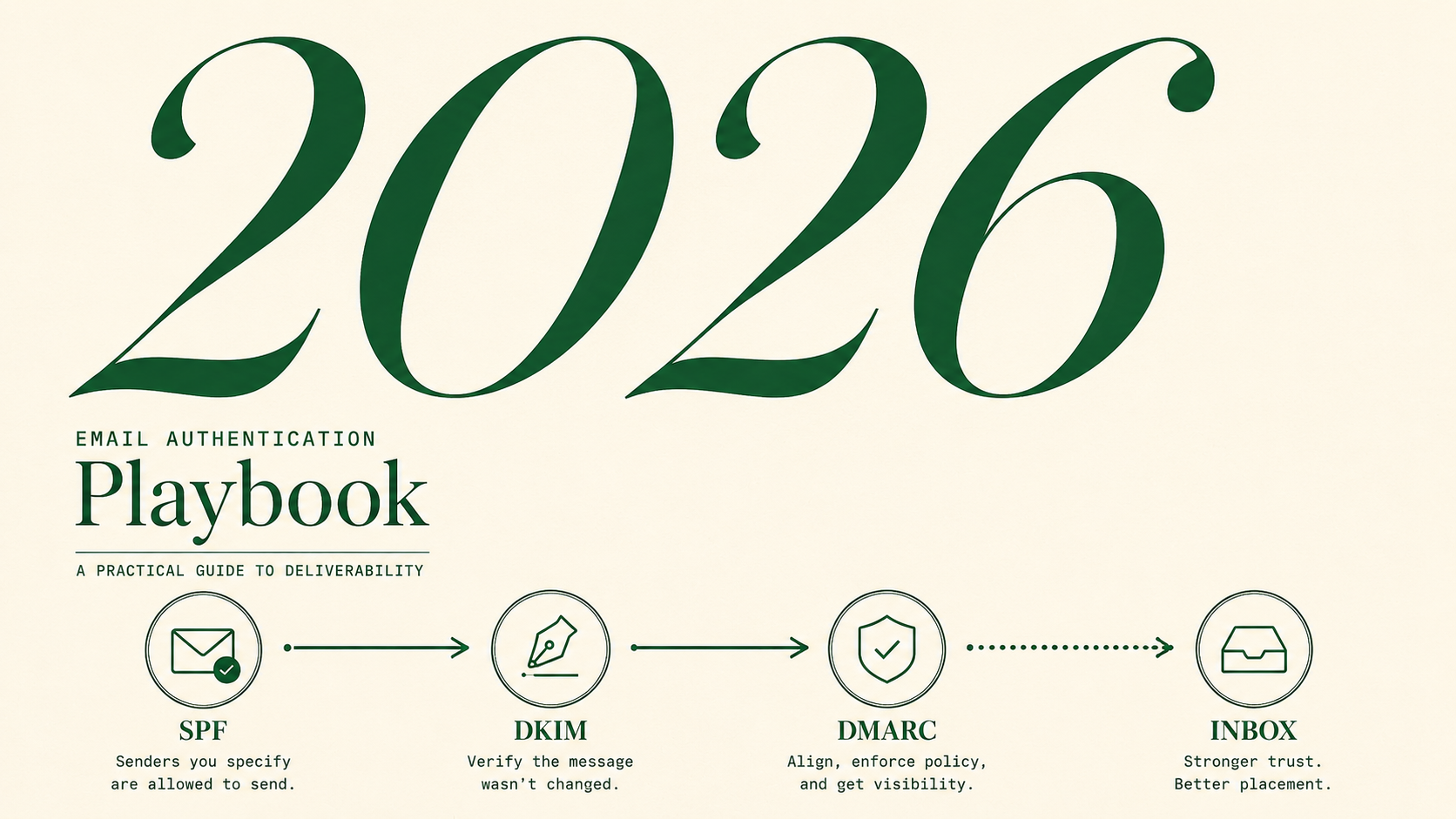
Email deliverability changed more between 2024 and 2026 than in the previous decade combined. Google and Yahoo's February 2024 requirements forced every serious sender to authenticate. Microsoft followed in 2025 with stricter spam-folder placement for non-aligned mail. And ISPs everywhere shifted from content-based filtering to behavior-based filtering — what your recipients do with your mail matters more than what's in it.
This playbook is what we'd tell a friend setting up email today. It's the version of the spec the loud people on LinkedIn won't write because it's not contrarian enough.
What actually changed in 2024–2026
Three shifts you can't ignore:
- DMARC enforcement is the new floor. If you send any meaningful volume (Google's threshold is 5,000/day, but the practical floor is lower), DMARC has to be in place with
p=quarantineminimum, and SPF + DKIM both have to align.p=noneis now a yellow flag at major ISPs, not a starting point. - One-click unsubscribe is mandatory. RFC 8058 header-based unsubscribe (
List-Unsubscribe-Post) is required for bulk senders. Footer links alone aren't enough. ISPs are surfacing the native unsubscribe button right in the inbox, and refusing to honor it tanks your reputation faster than complaints used to. - Engagement-based throttling is the dominant signal. ISPs no longer ask "is this mail compliant?" — they ask "do recipients open, reply, scroll, and click?" Mail to people who never open lands in spam regardless of authentication.
DMARC, DKIM, and SPF in 2026
The bare-minimum modern stack:
- SPF with
~allor-all— listing every IP or include that sends mail for your domain. - DKIM with 2048-bit keys, rotated annually. If you're using a sending platform, per-customer DKIM is the gold standard so one tenant's bad behavior doesn't poison the shared key.
- DMARC at
p=quarantinewith a real RUA mailbox you actually monitor.p=rejectonly after 60+ days of clean RUF reports. - BIMI (Brand Indicators for Message Identification) for senders with VMC certificates. It's not a deliverability lever directly, but it lifts open rates 5–15% by displaying your logo in the inbox.
Authentication isn't a deliverability strategy — it's a prerequisite to having one.
List hygiene is the cheapest lever you have
Most senders spend 90% of their time on content and 10% on list quality. Flip the ratio.
- Suppress hard bounces immediately. Forever. No "let me retry next month."
- Sunset disengaged subscribers. Anyone who hasn't opened in 180 days goes into a re-engagement flow; if they don't open the re-engagement, they're suppressed. Painful in the short term, transformative in the long term.
- Suppress role addresses (
info@,sales@,admin@) on consumer-facing campaigns. These tend to be shared, unmonitored, and trigger spam traps. - Run a verification pass before any major send to a list older than 90 days. The 8% you lose isn't revenue — it's the 8% that was going to bounce anyway and drag the other 92% with it.
Warm-up: still worth doing, but differently
The old advice — "send 50 emails on day one, 100 on day two…" — still works, but the more important thing in 2026 is seed-list signal. Send the first 500 messages to people who you know will open and engage. ISPs are watching the open/reply ratio on the first thousand mails from a new IP or new domain more than the raw volume curve.
If you're on a shared pool (most senders should be — dedicated IPs only make sense at 100k+/month), your warm-up is effectively the platform's job. Pick a platform with per-customer reputation isolation so your traffic doesn't get mixed with whoever else is sharing your IP block.
Engagement signals you should care about
Open rate is dead as a primary metric — Apple Mail Privacy Protection prefetches every open. Lean on these instead:
- Click-to-delivered ratio. Of mail that reached the inbox, what fraction got a click? Healthy is 2–8% depending on industry.
- Reply rate. Direct replies are the strongest positive signal an ISP can see. Encourage them. Use a real reply-to.
- "Move to inbox" rate. If recipients are pulling your mail out of spam, ISPs notice. This is rare but very high-signal.
- "Mark as spam" rate. Should be under 0.1%. Above 0.3% is a crisis.
- Time-in-thread. Some ISPs (notably Gmail) factor in whether recipients spend any time reading. A two-paragraph nudge often beats a long newsletter.
The eight numbers to watch
Build a weekly deliverability dashboard. Watch these eight, and only these eight:
- Inbox placement rate by major ISP (Gmail, Outlook, Yahoo, Apple) — use a seed-list service like GlockApps or Inbox Insight.
- Complaint rate (mark-as-spam / delivered). Target: < 0.1%. Action threshold: 0.3%.
- Hard-bounce rate. Target: < 0.5%. Investigate at 1%.
- Soft-bounce rate. Target: < 2%. Pattern matters — many "mailbox full" is fine, many "deferred" is a reputation problem.
- Unsubscribe rate. Healthy: 0.2–0.5%. Above 1% means your segmentation is wrong.
- Click-to-delivered ratio. Industry-specific; benchmark against yourself month-over-month.
- DMARC pass rate. Should be 99%+. Anything less is a misconfigured source.
- List growth rate. Net new subscribers minus churn. Negative growth is the early-warning sign that your engagement is sliding.
The 2026 sender checklist
Print this. Stick it on the wall. Do every line item.
- SPF, DKIM (2048-bit), DMARC
p=quarantineminimum, all aligned. - RFC 8058 one-click unsubscribe in the header on every campaign.
- Per-customer DKIM if you're on a sending platform.
- Hard bounces suppressed for life. No exceptions.
- 180-day re-engagement flow with a hard cutoff.
- Verification pass on any list 90+ days stale before a major send.
- Weekly seed-list test against Gmail, Outlook, Yahoo, Apple.
- Weekly review of the eight numbers above.
- A reply-to that's a real, monitored inbox.
- Plain-text alternative in every multipart message.
- No "Last chance!", "Free!!!", or 1990s-era trigger words in subject lines.
- BIMI + VMC if your brand justifies the $1,500/year.
What deliverability looks like in 2027
The trajectory is clear: behavior-based filtering keeps tightening, AI-driven reputation models get better at distinguishing "wanted" from "tolerated" mail, and the cost of being a mediocre sender keeps rising. The senders who'll be in the inbox in 2027 are the ones who treat their list like a trust account — earning permission daily, removing the bottom 20% without flinching, and never sending the email they wouldn't want to receive.
The technical pieces — DMARC, DKIM, one-click unsubscribe — are table stakes. The differentiator is discipline.